Best affiliate trackers for Meta and Google
You buy Meta or Google traffic to an offer. The ad account and the network disagree on the sale, and the next dollar follows whichever report you trust. Something has to hold the click and the network's later decision on the same record.
If the page, the checkout and the network postback need to share one record, I would start with that platform. If the funnel is already built and you still need the click stored, I would start with a dedicated tracker. The order below gives each of those jobs to one product.
Quick answer
ElasticFunnels is our top pick for most people. ElasticFunnels is the pick if the landing page, the checkout and the network postback have to live on one record.
- ElasticFunnels. Best for the page and the postback on one record. From $97/mo.
- RedTrack. Best for included CAPI. From $141/mo.
- ClickMagick. Best for an account with a visitor cap. From $79/mo.
- Voluum. Best for a million events. From $119/mo.
Compare the entry plans
The figure is the vendor's entry price. When a vendor prices a year and a month separately, both amounts show in the cell.
| Tool | Entry price | Trial | Entry meter | Server signal | From |
|---|---|---|---|---|---|
| 1. ElasticFunnels | $97/mo | 14 days, no card | 50,000 page views | Meta CAPI and Google click upload | $97/mo |
| 2. RedTrack | $141/mo annual | 14 days | 5 million events | On every affiliate plan | $141/mo |
| 3. ClickMagick | $79/mo | 14 days | 10,000 visitors | On Starter | $79/mo |
| 4. Voluum | $119/mo annual | 14 days, no card | 1 million events | Signals back to ad platforms | $119/mo |
The ranking
Each product below has one job. The full review has the rest.
1. ElasticFunnels: best for the page and the postback on one record
ElasticFunnels is a funnel platform. The page, a same-URL split test, the checkout and the attribution share one record, which is why it ranks first. A network can post the sale back onto that record. A Meta Purchase goes out through the Conversions API, and ad spend comes back in. The ElasticFunnels review follows that sale from the click to the postback. Read what else to open if you leave ElasticFunnels. ElasticFunnels vs ClickFunnels is the head-to-head with the other funnel builder.
1. ElasticFunnels
The sales funnel builder for paid traffic
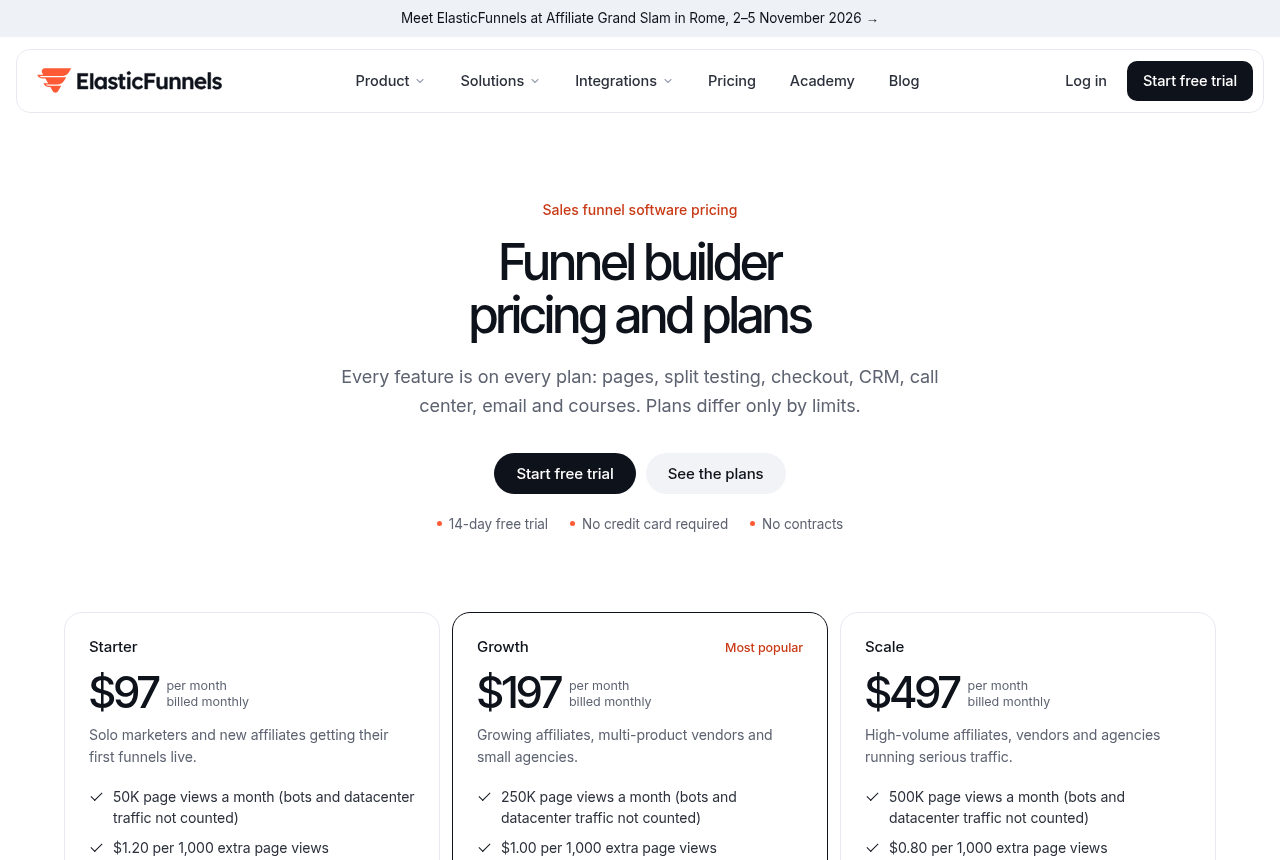
Our take: ElasticFunnels is the pick if the landing page, the checkout and the network postback have to live on one record.
What works
- The page, the checkout and the sale sit on one record, and a network can post that sale back.
- Same-URL split tests keep the ad link stable while the variants rotate.
- Meta Purchase events can go out through the Conversions API, and spend can come back in.
What to watch
- Independent reviews are still scarce, which is what you would expect of a platform launched in 2023. Until more buyers run volume through it, postback and conversion tracking details come from the vendor's documentation.
2. RedTrack: best for included CAPI
If the funnel is already built, this is the tracker a new account starts on, and the server-side signal and spend sync are included. The event allowance is the number you outgrow. The RedTrack review covers what you pay once you pass that allowance. If you are leaving that plan, the alternatives page is the next stop. The monthly allowance is listed in full on the same review.
2. RedTrack
Ad tracker for affiliate media buyers
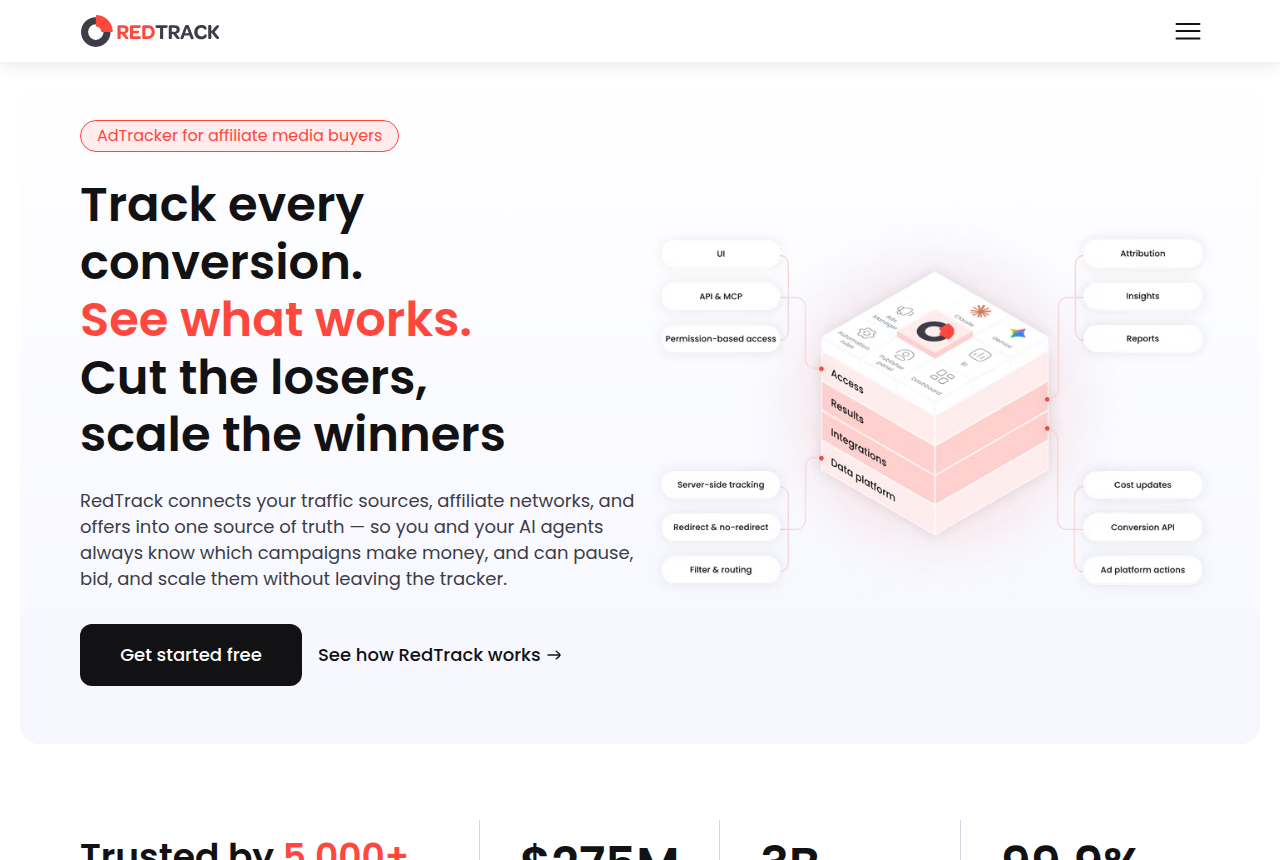
Our take: RedTrack is the one to choose if you want the Meta and Google conversion API, and ad spend sync, on the first affiliate plan.
What works
- A native conversion API for Meta and Google is included on every affiliate plan, including Solo.
- The affiliate pricing page states there is no ad-spend limit. Plans are metered by events.
- Redirect tracking and direct tracking without a redirect are both included on every plan.
What to watch
- Solo includes one login.
- Traffic past the monthly event allowance is still tracked, and you pay for each extra thousand events.
- Paying month to month costs more than paying for the year.
3. ClickMagick: best for an account with a visitor cap
This pick is for a visitor cap and one connected account. The ClickMagick review goes through Starter. Switching because of the visitor cap starts on the alternatives page. That same review also spells out the cap.
3. ClickMagick
Ad tracking software and conversion attribution
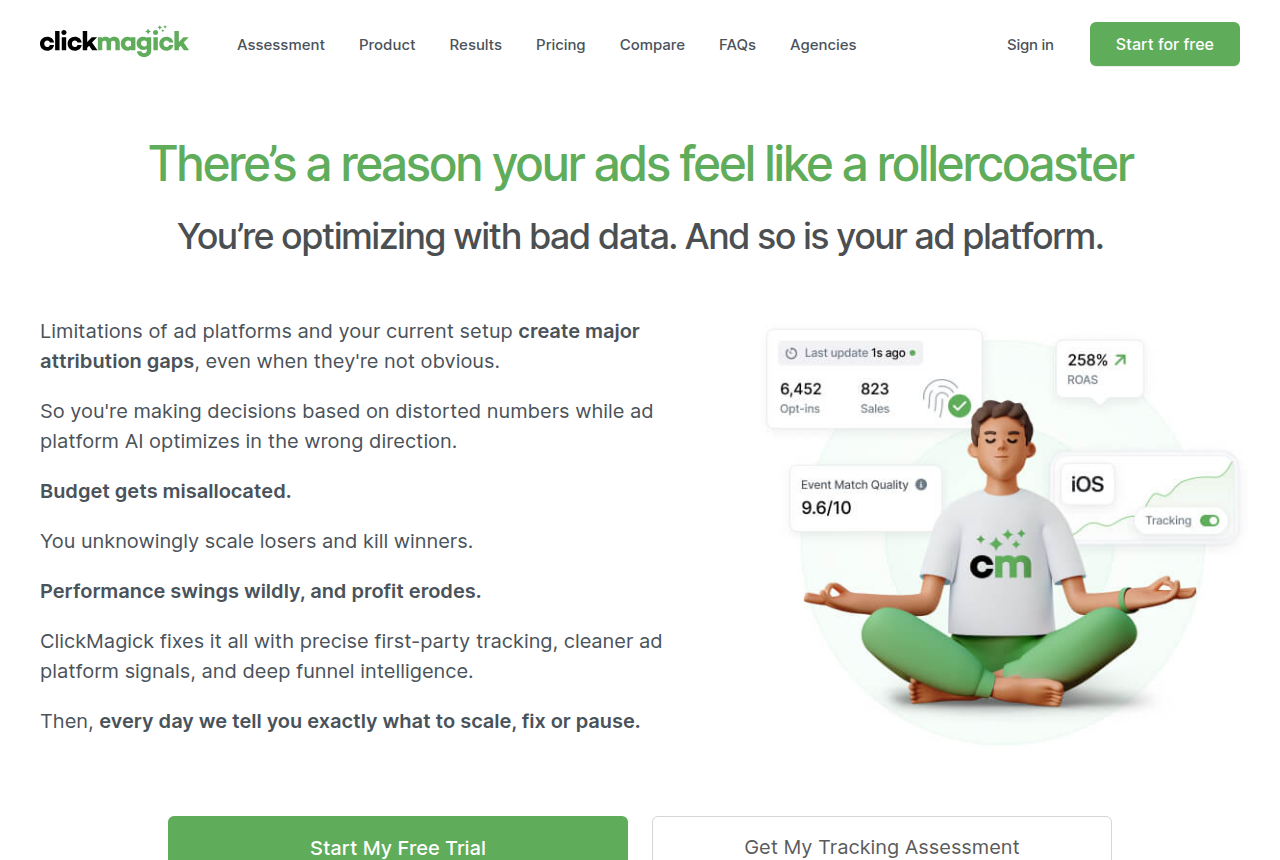
Our take: ClickMagick works for a small account that wants CAPI and can stay within the visitor limit.
What works
- Starter includes Audience Optimization, which the pricing page lists as CAPI.
- The entry plan is the lowest of the three we priced, and the trial is 14 days.
- A first-party tracking domain is on the Starter feature list.
What to watch
- Starter includes 10,000 tracked visitors and one ad account per platform.
- Affiliate campaigns without a cap are listed on Standard. Starter keeps data for six months.
- The pricing page does not state what happens once you exceed the visitor allowance.
4. Voluum: best for a million events
The allowance is a million events, and campaigns that can be active at once are capped separately. The Voluum review explains that cap. Read the page for a move off Profit. What the cap does to the bill is in the same review.
4. Voluum
Ad tracker for media buyers running profitable ad campaigns
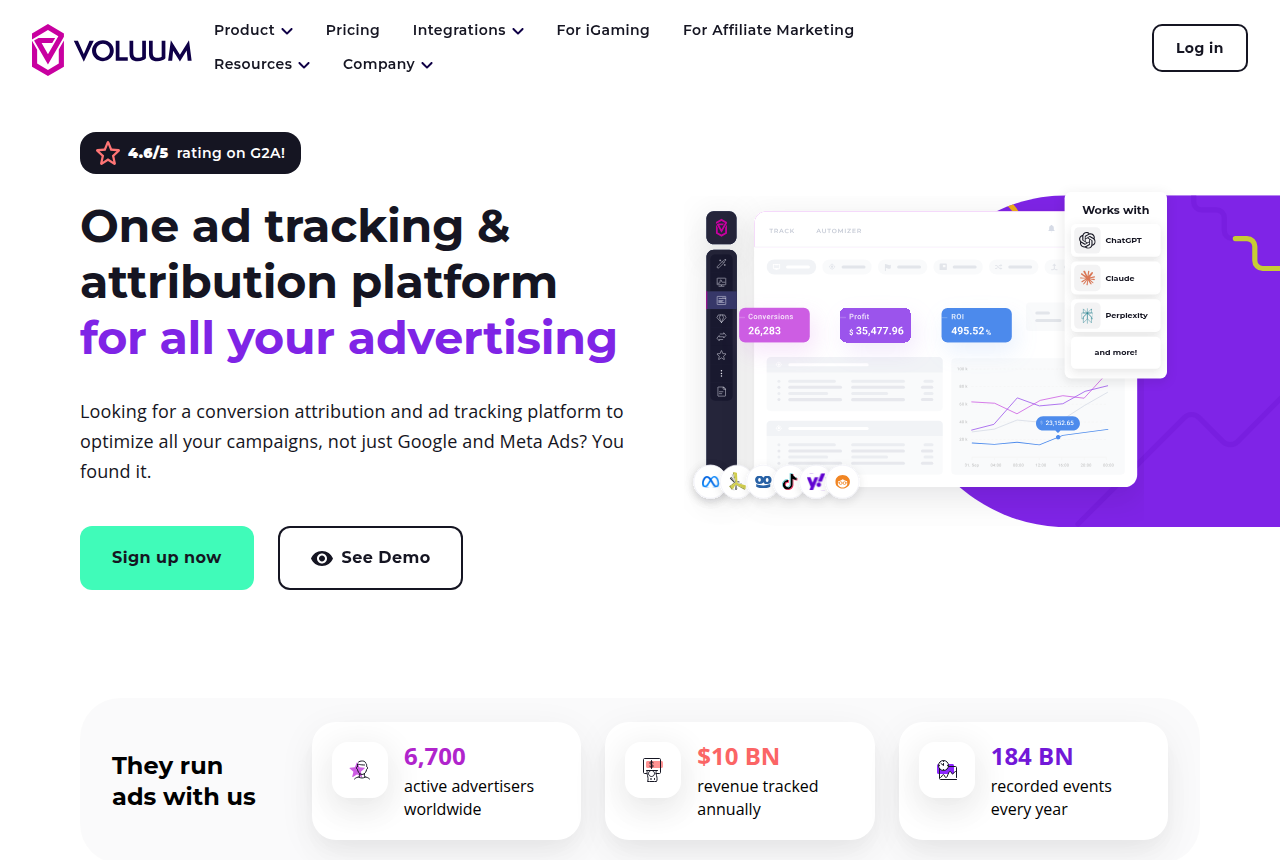
Our take: Voluum is the pick if you already need a million events and traffic distribution, and you can work inside 20 active campaigns.
What works
- Profit includes up to 1,000,000 events.
- Traffic Distribution AI is on the Profit feature list.
- The homepage offers a 14-day platform preview and says no payment details are required.
What to watch
- Profit includes 20 active campaigns.
- Auto-rules and API integrations are free only up to $1,000 of ad spend a month, then Automizer is a separate subscription.
- Public reviews describe the setup as more complex than a visitor-capped tracker, and say the price pays off once ad spend is high enough to use the allowance.
Winners by situation
The page, the checkout and the postback are one job
ElasticFunnels is a funnel platform, so the page, the checkout and the attribution already share a record. A network sale posts back onto that record, and a Meta Purchase goes out through the Conversions API. The runner-up is RedTrack, for a buyer whose pages and checkout are already hosted and who needs the click stored, with the server-side signal included on the plan they start on.
One ad account on Meta and one on Google
That buyer is still inside a visitor allowance and one ad account on each platform. ClickMagick includes the server-side signal on the entry plan, and a first-party tracking domain on that plan too. The limit you hit next is a second ad account, or the visitor cap. Affiliate campaigns without a cap are on the tier above, so someone already rotating offer links should read that line before they pay. RedTrack is the runner-up when you need a second account or spend sync.
Server-side signal on the plan you start on
RedTrack includes native signals for Meta and Google on every affiliate plan, including the one you start on, and it syncs ad spend with no spend limit. Solo is one login and five ad accounts on each platform. Events past the monthly allowance are billed per thousand. A pop or push buyer sending a lot of clicks should include that overage in the price, because the allowance is not a hard stop. Voluum is the runner-up when your event count is already past a small plan and your live offers still fit the campaign limit in the next section.
A million events, and traffic you want distributed
Voluum includes up to a million events on Profit, and traffic distribution is on that plan. Buyers who duplicate offers all week hit the active-campaign limit before they fill those events. The Facebook section below compares that limit with the other two entry plans. Ad spend sync is included only up to a small monthly spend, and after that it is a separate subscription. See that second bill before you assume spend is included. The preview is fourteen days and the vendor says it does not ask for payment details. RedTrack is the next choice when you will add campaigns and the event allowance still has room.
Best affiliate tracker for Facebook ads
The plan that fits is the one whose first limit matches how you buy.
If the page and the checkout are part of the same job, the funnel platform at the top of the ranking still stands. The three tracker plans here are for a funnel hosted on another platform, or for a Facebook campaign count that passes the event allowance.
Profit meters a shared event pool, and it stops at 20 active campaigns. Ten impressions count as one event, and a visit, a click, and a conversion each count as one. Voluum's pricing page lists those weights. You can still have events left when that cap blocks a new offer. On Facebook that happens when a new offer, or a new country, means a new campaign.
Solo leaves campaigns, landers, and offers uncapped. RedTrack's pricing page meters that plan by clicks and conversions, so a long offer list runs into the event meter. The ad-account count on Solo is in the server-side section above.
Starter allows one Meta account and one Google account. The visitor allowance is in the table, and campaigns without a cap are on the next tier, in the one-account section above. The limit is how many accounts you can connect.
RedTrack vs Voluum is the offer-count choice. ClickMagick vs Voluum sets one account next to that campaign allowance. RedTrack vs ClickMagick covers adding a second Facebook account. Binom vs Voluum is the license you host, set against that campaign cap.
Open Solo when the next offer has to stay live and plenty of events remain. Stay with Profit when every offer you need can stay live together. If you only need a higher campaign limit, Voluum's next tier lists 60 campaigns and 5 million events. A Facebook account with a visitor count you can predict stays on Starter.
Why Purchases and approved sales disagree
SweetCode's note on conversion discrepancies describes Ads Manager's Purchases column as a count of attributed conversions. The figure an affiliate network pays is its approved sales. A buyer who bids against Purchases is bidding against the attributed total.
The two totals pull apart in ordinary ways. Littledata's tracking guide says Meta keeps one event when a browser event and a server event share the event name and the event id for the same pixel, within 48 hours, and that Meta cannot deduplicate across tools that use different ids. Facebook pixel vs Conversions API shows how to put the same id on both events. The same window is written in Meta's server-side spec. Timing is the other split. ClickFlare's note on mismatched conversions says a real-time postback can register a conversion before the network rejects or adjusts it, so Ads Manager can list a purchase the network never pays.
Compare the two totals before you change the bid. The purchase gap calculator compares Purchases with approved, held, and rejected sales for one date range, and it names a likely cause from the numbers you type.
What to leave alone
A bid trained on the Purchases column
Leave that column out of the bid until it has been lined up with approved sales. The section above compares those two totals.
A feature list that starts two tiers up
Judge the plan you will actually be billed for. A server-side signal, a second user, or unlimited offer links can be on a higher tier than the price at the top of the vendor's page. Read the bullet list under the plan name you will pay for.
A link shortener used as the system of record
A shortener can count a click and pass a parameter. It does not file the approval, the hold or the rejection against that click, and it does not give you a place to correct what the ad platform believes. Use one for a clean link. Use a tracker for the payable lead.
How we ranked these
We read what long-term users report in public threads and review sites, check vendor documentation and pricing pages, and verify prices with each vendor before we write a verdict.
Each product is given one job the others do not share. ElasticFunnels is first because the page, the checkout and the postback can share a record, and its pricing page says every feature is on every plan, so the Meta Conversions API is on the plan you start on. The three trackers are then ranked by the plan each vendor sells to a new account. The sequence is 1, 2, 3, 4, with no numeric score beside the name.
Five checks decide which job a product gets. Is the server-side signal on the plan you start on? Which unit does the meter count? How many ad accounts, users and active campaigns does that plan include? Is cost sync inside the plan, or does it need a second subscription? What does the vendor say about the trial, including whether it asks for a card?
Prices in the table come from each vendor's pricing page: ElasticFunnels, RedTrack, ClickMagick and Voluum. How the first of those sends Meta conversions is on its Meta Ads page. Public threads tell us which limit buyers argue about. They do not override a figure the vendor's own page states. Google describes the hashed first-party data an ad account can receive in enhanced conversions, and the Ads API setup describes sending a click id with the conversion.
Read the methodology page for the full standard. This page is updated when that first bill changes, and every ninety days if the bill stays put.
How to choose
Sketch the next ninety days of accounts, clicks and campaigns before you open a trial. A plan that looks cheap for one account becomes the wrong bill when the media buying changes.
- Count the ad accounts you will connect, per platform. One Meta account and one Google account need their own plan, and five accounts need another.
- Decide whether the ad platform has to receive the network's decision in the first week, including a lead the network approves after the click.
- Name the unit you can predict. Visitors, if the site is still small. Events, if you already know clicks plus conversions will be large. Active campaigns, if you duplicate offers faster than you duplicate spend.
- Check whether cost sync is on the same plan or on a second subscription. Spend that lives in a separate product is a second bill.
- Read the vendor's own trial terms. Count the days, and see whether a card is required to start.
Then open the review for the tracker that still fits those five checks. That review puts the drawbacks next to the reason to pay.
For the page, the checkout and the postback on one record, read ElasticFunnels. For the server-side signal on the plan you start on, read RedTrack. A buyer still on one account per platform should read ClickMagick before opening a trial. Someone already counting events in the millions should start with Voluum.
What a tracker is doing
An affiliate tracker stores the click, keeps the click id, and waits. When the network approves, holds or rejects the lead, it calls back to a URL on the tracker. That call is the postback. The tracker stores that result against the click the ad paid for.
The browser pixel fires while the person is still on the page. It can say a click happened, or that a thank-you page loaded. It cannot see a rejection that arrives after the person has left. Buyers who ask for a conversion API want the network's decision sent from a server. Google's help page calls one receiving path enhanced conversions, and the Ads API page describes attaching a click id to that conversion.
Direct, no-redirect tracking and a classic redirect do the same filing job by different routes. A redirect sends the click through the tracker before the offer. A direct setup puts the offer URL in the ad, and the tracker still receives the click and the later postback. RedTrack states that both are on every plan. The choice is a compliance and page-speed choice, and it is separate from which plan includes the server-side signal.
Ad spend inside the tracker is a separate feed. The ad platform's spend has to be imported and set next to the leads the network actually paid. A plan can track the lead and still leave spend on a higher tier or a second product. That is why the meter and the spend sync are two lines in the table.
Questions
Which tracker should a new Meta and Google buyer open?
Can the ad account stand in for a tracker?
What is a postback?
Why do two entry prices look close and behave differently?
When does this page change?
Changelog
. You can hit Profit's campaign limit before you use up its events. This update sets Solo and Starter next to that case, and it explains why Purchases and approved sales disagree, with links to the pixel page and the purchase gap calculator.
. First version. ElasticFunnels is first when the page, the checkout and the postback are one job. Three trackers follow, ordered by the job the first tracker invoice does. Prices and meters come from each vendor's pricing page.
What we read
- ElasticFunnels pricing
- ElasticFunnels Meta Ads integration
- RedTrack pricing
- ClickMagick pricing
- Voluum pricing
- Facebook conversion discrepancies
- Meta ads tracking guide
- Meta server-side spec
- Why conversions do not match
- About enhanced conversions
- Enhanced conversions for web
Related reading
- All reviews, one product per page.
- Head-to-heads when the choice is already down to two.
- RedTrack vs Voluum, an offer list against an open campaign list.
- ClickMagick vs Voluum, the visitor plan beside the event plan.
- BeMob vs Voluum, a free event cap beside Profit's pool.
- Binom vs Voluum, the license you host beside Profit.
- RedTrack vs ClickMagick, for when you need a second ad account.
- Alternatives when you are leaving a tracker.
- How we research.
- Which tracker plan fits your traffic, by clicks, events, campaigns and ad accounts.
- Ads Manager purchases against actual sales, beside approved, held and rejected.
- Facebook pixel vs Conversions API, what each path sends on a sale.
Written by
Nadia Lindqvist
Affiliate tracking
Nadia covers affiliate tracking software for people who buy Meta and Google traffic. She reads vendor pricing pages, documentation and long-term user reports, and she writes about which tracker fits a given buyer.
Last checked 2026-10-18